By Diogenes Monegro · · 9 min read
The Power of Machine Learning for Small Business: 5 Real Uses with a Hardware Store Example
What machine learning is in plain language, what 2026 data says about who is adopting it, and 5 ways to use it in a small business, applied to a hardware store: demand forecasting, at-risk customers, segmentation, cross-selling and anomalies.
Your sales system stores every invoice, every customer and every product that went out the door. Years of history. Most small businesses use that information for one thing: knowing how much they sold last month.
Machine learning uses that same history to answer a different, far more valuable question: what's going to happen. How much you'll sell next week, which customer is about to leave, which product is about to run out. And it's no longer technology just for big companies.
In this article we explain what it is in plain language, what the latest data says about who is using it, and we apply it to a very common business: a hardware store.
What machine learning is, without the jargon
Machine learning is a way of programming where you don't write rules for the computer: you give it examples and it finds the rules.
A hand-written rule would say: "if fewer than 50 bags of cement are left, order 200." A machine learning model looks at three years of sales and learns on its own that cement goes up in the dry season, drops in rainy weeks, spikes before long holiday weekends and sells more when there are big construction projects nearby. With that, it proposes how much to order each week, and it adjusts every time new data comes in.
Almost everything we call artificial intelligence today runs on machine learning. But it helps to separate two uses:
- Generative AI, like ChatGPT or Gemini: it writes, summarizes and chats. It's useful for office work, and we compare the two in our guide to ChatGPT vs. Gemini for business.
- Predictive machine learning: it learns from your business's numbers to forecast, classify and flag what's unusual. That's the one we cover here.
The practical difference: ChatGPT knows a lot about the world, but it doesn't know your sales. A predictive model trained on your data knows your business better than anyone.
What the 2026 data says
Three recent U.S. sources show where things stand.
The Census Bureau, in its Business Trends and Outlook Survey, found that between December 2025 and May 2026, between 17% and 20% of businesses were using artificial intelligence in their operations. But use depends heavily on size: 37% of firms with 250 or more employees already use it, compared with less than 20% of firms with four or fewer employees. And the most telling finding: over that period, use grew among firms with 20 or more employees but didn't change significantly among those with fewer than 20.
The Federal Reserve, combining that survey with other sources, estimated that about 18% of firms had adopted AI by the end of 2025, yet 78% of the labor force already works at firms that have adopted it. It adds an important nuance: adoption among the smallest firms is stronger than size alone would predict. Small businesses that take the leap move fast.
The U.S. Chamber of Commerce, in its 2026 small business report, found that 66% of small businesses now use AI, nearly three times the 23% of 2023. Small businesses using AI are at least 7 points more likely to report sales, profit and workforce growth than those that don't. 47% say AI is creating jobs; only 6% say it's enabling headcount reductions.
The Chamber and Census figures aren't directly comparable: they're different surveys, with different questions and samples. Together they tell a clear story. Many small businesses are already trying AI tools, but larger firms are the ones building it into their day-to-day operations. That gap is your opportunity: machine learning applied to your own data is still an edge your small competitors most likely don't have.
The hardware store in our example
Picture a hardware store with two locations and 18 employees. It sells about 6,000 different products, from screws to cement and paint, to three kinds of customers: households, independent tradespeople and around 900 contractor accounts with credit.
It has three years of sales in its point-of-sale system. And it has the usual problems:
- Key products run out right when they sell the most, while cash sits tied up in stock that doesn't move.
- It finds out a big contractor went to the competition when they've already gone two months without buying.
- It treats every customer the same: the same offer for the contractor who buys every week and for the household that comes in once a year.
- It has no way to spot unusual discounts or suspicious returns in time.
All of that can be tackled with data it already has.
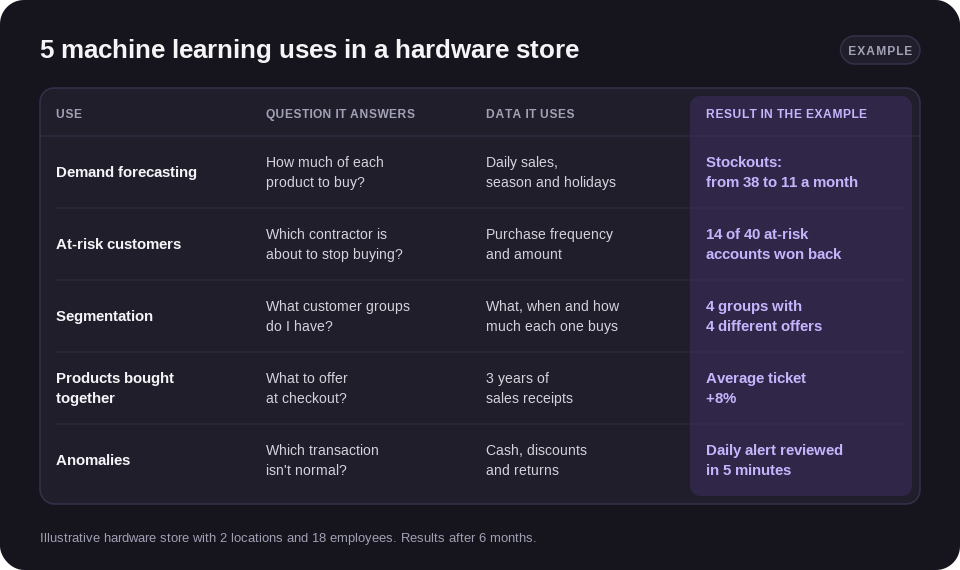
5 machine learning uses, applied
1. Demand forecasting: buy just what you need
It's the fastest-payback use for any business that carries inventory. The model learns each product's sales pattern (trend, season, holidays, promotions) and forecasts how much will sell in the coming weeks.
At the hardware store, the old method was to order based on the average of the last eight weeks. The problem is that an average always arrives late: when the busy season starts, it's still thinking about the slow one.
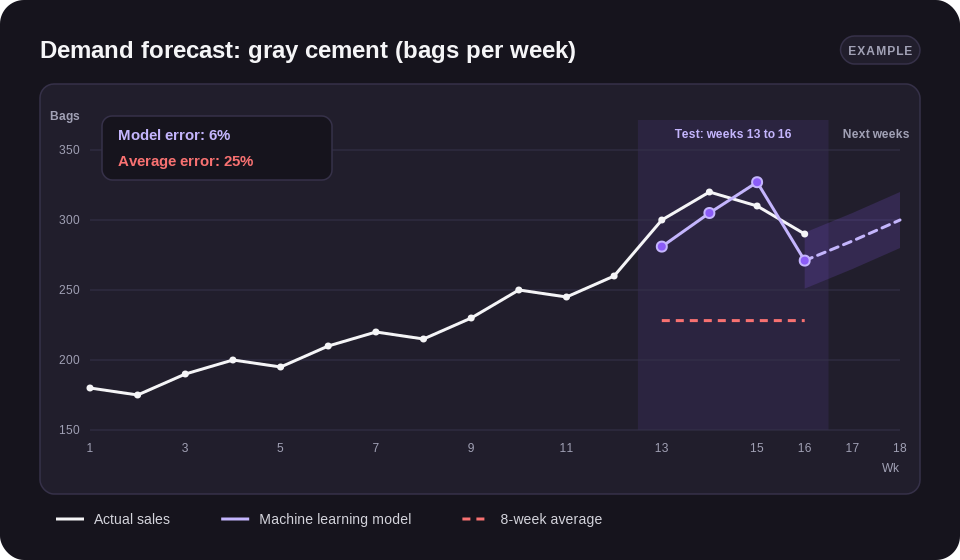
Before trusting the model, it was tested against the past: trained on the first 12 weeks and compared with what actually sold in the next four. The average was off by 25%; the model, by 6%.
Applied to the 300 best-selling products, stockouts dropped from 38 to 11 a month, and slow-moving inventory fell 15% because the store stopped buying "just in case."
2. At-risk customers: call before they leave
A classification model learns how a customer behaves before leaving: they buy less often, each purchase gets smaller, they stop buying certain categories. Every Monday it gives each account a risk score.
At the hardware store, the model flagged 40 contractor accounts as at risk in the first month. The sales manager called every one: some had an unresolved delivery problem, others had been offered a better price elsewhere. 14 went back to buying regularly. Before, those accounts would have been written off without anyone noticing.
3. Segmentation: the right offer for each customer
A clustering algorithm looks at what each customer buys, how often and how much, and forms similar groups without being told which ones to look for.
At the hardware store, 4 groups emerged: large contractors who buy volume every week, independent tradespeople who buy a little but often, households who come in on weekends for one-off projects, and small corner stores that resell basic items. Each group got a different offer: volume pricing, fast credit, project bundles and a monthly restock list.
4. Products bought together: sell more at checkout
By analyzing sales receipts, the model finds which products are bought together more often than chance would explain. People who buy paint almost always take a roller, a brush and masking tape; people who buy PVC pipe usually need cement and elbows.
The hardware store put those suggestions on the cashier's screen and rearranged a few aisles. The average ticket rose 8%, without a single extra promotion.
5. Anomaly detection: see what's off in time
An anomaly model learns what a normal day of cash, discounts and returns looks like, and alerts you when something breaks the pattern.
At the hardware store, the daily alert takes 5 minutes to review. In the first few weeks it showed that one register user was applying discounts three times higher than everyone else, and a cluster of returns without a receipt concentrated in the same shift. Not everything unusual is fraud, but everything unusual deserves a question.
The hardware store's numbers are illustrative: yours will be different. What repeats is the pattern: none of these models needed new data. It was all already in the point-of-sale system.
What you need to get started
You don't need a team of data scientists or a big-company budget. The most widely used Python libraries for this, like scikit-learn, are free. What you do need:
- A concrete business question. Not "I want to use AI," but "I want to stop running out of cement in the busy season."
- Enough history. For forecasts, ideally one or two years of sales, so the model sees each season at least once.
- Clean data. If the same customer shows up three times under different names, the model learns the mess. Check our guide to data governance for small business before you start.
- Someone who acts. A prediction nobody looks at is worth nothing. Each model needs an owner: the buyer, the person who calls the customer, the person who reviews the alert.
- An honest comparison. Test the model against what you do today, using weeks that already happened, like in the chart above. If it doesn't beat your current method, don't use it.
Common mistakes
- Starting with the most complex model. A good demand forecast that people actually use is worth more than a neural network nobody understands.
- Trying to predict everything at once. Start with one use, measure the result, then add the next.
- Skipping dashboards. If you still can't see clearly what already happened, first build your metrics with our practical guide to business intelligence for small business. Machine learning is the next step, not the first.
- Training once and forgetting about it. Patterns change: a model that isn't retrained on new data falls behind.
- Trusting it blindly. The model suggests, the person decides. In the first few weeks, always compare the suggestion with your own judgment.
Your next step
This week, write down the question that costs you the most money not being able to answer: which product will run out, which customer will leave, where margin is leaking. Then check whether you have at least a year of data on it.
If the answer is yes, you already have a machine learning use case. At ShineTechData we build machine learning models for small businesses: we review your data, pick the use with the best return, test it against your current method and leave it running inside the tools you already use.
Sources
- Large Firms With at Least 20 Employees Biggest AI Users(opens in a new tab) — U.S. Census Bureau (Business Trends and Outlook Survey), 2026
- Empowering Small Business: The Impact of Technology on U.S. Small Business (2026)(opens in a new tab) — U.S. Chamber of Commerce Technology Engagement Center, 2026
- Monitoring AI Adoption in the U.S. Economy(opens in a new tab) — Board of Governors of the Federal Reserve System (FEDS Notes), 2026
About the author
Diogenes MonegroCEO, ShineTechData
Diogenes Monegro is the CEO of ShineTechData, a data and AI consultancy based in San Pedro de Macorís, Dominican Republic, that helps small and mid-sized businesses put their data to work.